How Biophilic Wall Art Boosts Productivity: The Science Behind Nature Inspired Workspaces
Let me ask you something. When was the last time you felt truly focused at work? Not just going through the motions, but genuinely locked in, where hours passed like minutes and you accomplished more than you thought possible? For most of us, those moments are becoming rarer by the day.
Here’s something you might not have considered: the answer to your productivity struggles might not be another app, time management system, or motivational podcast. It could be as simple as changing what you look at every day. Enter biophilic wall art, the surprisingly powerful tool that’s transforming how we work, think, and perform in our daily spaces.
If you’re wondering whether hanging a picture of a forest on your wall can actually make you more productive, I get the skepticism. I had it too. But the research tells a compelling story that’s worth paying attention to, especially if you’re struggling to maintain focus in today’s chaotic work environment.
What Exactly Is Biophilic Art?
Before we dive into the productivity benefits, let’s clear up what we’re actually talking about here. Biophilic art isn’t just “nature pictures.” It’s a deliberate design approach rooted in something called the biophilia hypothesis, which basically says that humans are hardwired to connect with nature because, well, we evolved surrounded by it for millions of years.
Biophilic art uses elements like plants, water, natural landscapes, organic patterns, and even representations of natural light to create that sense of connection within built environments. It can be straightforward, think photographs of forests or oceans, or more abstract, using colors, patterns, and textures that echo what we’d find in nature.
The key is that these aren’t random pretty pictures. They’re intentionally designed to tap into our brain’s innate response to natural environments. And that response, as it turns out, has some pretty remarkable effects on how we work.
Biophilic Wall Design: More Than Just Decoration
When we talk about biophilic wall design, we’re discussing a strategic approach to transforming your workspace walls from blank canvases into active tools for better performance. This goes beyond aesthetics, though beauty certainly plays a role.
Think about the typical office wall. Blank white, maybe beige if you’re lucky, perhaps a generic motivational poster that’s been there so long you’ve stopped seeing it. Now imagine instead looking up from your screen to see a serene forest path, dappled morning light filtering through trees, or the calming expanse of a still lake. The difference isn’t just visual. It’s neurological, psychological, and yes, measurable in terms of your work output.
Recent workplace research from the University of Minnesota shows that workers in environments with more natural elements are 6% more productive, 15% more creative, and report 15% higher levels of wellbeing. That’s not a small difference. For a team of 20 people, that’s like adding an entire extra person’s worth of creative output.
How Your Brain Actually Responds to Biophilic Artwork
Here’s where things get fascinating. Your brain doesn’t process biophilic artwork the same way it processes other images. When you look at nature-inspired art, something specific happens in your cognitive processing that directly impacts your ability to work effectively.
The Attention Restoration Effect
There’s a concept in psychology called Attention Restoration Theory, developed by Rachel and Stephen Kaplan. The basic idea is this: your brain has two types of attention. Directed attention is what you use when you’re forcing yourself to focus on work, ignoring distractions, pushing through when you’d rather be doing something else. It’s effortful, limited, and gets depleted throughout the day.
Then there’s involuntary attention, or what the Kaplans call “soft fascination.” This is the effortless kind of attention that happens when you watch clouds drift by, listen to rustling leaves, or gaze at gentle waves. Your attention is engaged, but it doesn’t feel like work.
Nature imagery triggers this soft fascination response, giving your directed attention system a break to recover. Studies show that even brief exposure to nature scenes can reduce cognitive load and improve performance on attention-demanding tasks. After just 40 minutes of exposure to natural environments or nature media, people show measurable improvements in working memory and attentional control.
In practical terms? That picture of a forest on your wall isn’t just decoration. It’s giving your exhausted brain micro-breaks throughout the day, allowing you to maintain focus for longer periods without burning out.
The Stress Reduction Pathway
Let’s be honest about modern work life. It’s stressful. Deadlines, emails, meetings, notifications, interruptions. Your nervous system is basically in fight-or-flight mode for eight hours straight. And stress, as you probably know from experience, absolutely destroys productivity.
This is where biophilic art really shines. Research on workplace biophilic design demonstrates that viewing nature images literally lowers physiological stress markers. We’re talking about measurable decreases in cortisol levels, reduced blood pressure, and slower heart rate. This happens within 5 to 20 minutes of exposure.
When your stress response is constantly activated, your cognitive resources get diverted away from complex thinking, creativity, and problem solving. You’re basically operating on survival mode. By reducing that stress response through regular visual contact with nature imagery, you free up mental energy for the actual work you need to do.
Employees in biophilic workplaces report better sleep, greater emotional stability, and improved overall wellbeing. All of these factors directly support sustained work performance. You can’t be productive when you’re exhausted, anxious, and emotionally drained.
Biophilic Interior Design: Creating Productive Spaces
Now, you might be thinking, “Okay, this sounds great in theory, but what does this actually look like in practice?” Fair question. Let’s talk about how biophilic interior design principles translate into real productivity gains.
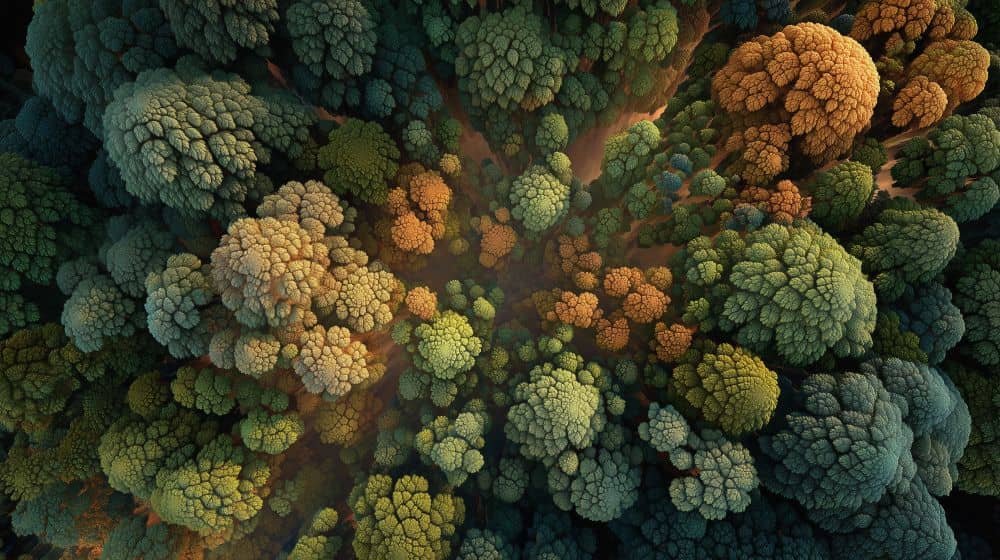
The most effective approach combines multiple natural elements. Yes, wall art plays a crucial role, but it works even better when integrated with other biophilic features like plants, natural materials, and access to daylight. However, if you can’t control all these factors, especially in rented office spaces or corporate environments, biophilic wall art becomes your most accessible and impactful intervention.
A systematic review of biophilic design in workplaces found significant psychological, physiological, and cognitive benefits, with the magnitude of effects varying based on specific design patterns. The key is consistency and visibility. Nature imagery needs to be in your direct line of sight, not hidden in a corner you never look at.
Think about your typical work posture. You’re at a desk, looking at a screen, occasionally glancing up. Where do your eyes naturally go during those moments? That’s where your biophilic art needs to be. Creating visual escape points throughout your workspace gives your brain regular opportunities for those restorative micro-breaks we talked about earlier.
The Optimal Dosage Question
Here’s something interesting that researchers have been exploring: how much nature imagery is enough, and when does it become too much?
A fascinating study tested different “greenery doses” in office environments, measuring everything from physiological brain activity to psychological responses to productivity performance. They tested green coverage ratios from 0% up to 20% and found something surprising.
Too little (0.2% or 5% coverage) wasn’t enough to create meaningful restorative effects. But 20% was actually too much, creating a sense of overwhelm. The sweet spot? About 12% green coverage ratio, which balanced psychological restoration, positive physiological changes, and improved productivity without overstimulation.
In practical terms for your workspace, this means you don’t need to cover every wall with forest scenes. Strategic placement of a few high-quality biophilic art pieces is more effective than plastering nature images everywhere.
The Productivity Benefits: What The Data Actually Shows
Alright, let’s get specific about what we mean by “boosts productivity.” Because that phrase gets thrown around a lot without real substance behind it.
Studies from UK researchers found that adding potted plants to a bare office increased productivity by 15%. A biophilic environment also improved short-term memory by 14%. Participants in green offices reported higher workplace happiness, better concentration, and improved perceived air quality compared to workers in spaces without natural elements.
But productivity isn’t just about raw output. It’s also about the quality of your thinking. Research on biophilic office design shows that employees in nature-enriched spaces demonstrate enhanced creativity and innovation, performing better on memory and attention tests.
Here’s a comparison table breaking down the specific productivity benefits documented in research studies:
| Productivity Metric | Improvement Rate | Supporting Evidence | Impact on Work Quality |
|---|---|---|---|
| General Productivity | 6 to 15% increase | University of Minnesota study, UK workplace research | More tasks completed, faster project throughput |
| Creative Output | 15% increase | Human Spaces survey data | Better problem solving, more innovative solutions |
| Short-term Memory | 14% improvement | University of Exeter research | Fewer errors, better information retention |
| Attention Performance | Low to moderate effect sizes | Systematic reviews of ART studies | Sustained focus, fewer distractions |
| Cognitive Flexibility | Measurable improvement | Meta-analysis of 49 studies | Better task switching, adaptability |
| Stress Recovery | 5 to 20 minute reduction in cortisol | Physiological marker studies | Less burnout, more consistent performance |
| Job Satisfaction | 15% higher reported wellbeing | Multiple workplace surveys | Lower turnover, better engagement |
| Absenteeism | 10 to 15% reduction | Office design case studies | More consistent staffing, project continuity |
Look at those numbers again. A 15% reduction in absenteeism alone can transform an organization’s operational efficiency. When you combine that with the creativity and memory improvements, you’re looking at compound effects that go way beyond what any productivity app could offer you.
Biophilic Wall Art Design: Choosing What Actually Works
So you’re convinced. You want to add biophilic wall art to your workspace. Great. But not all nature imagery is created equal, and this is where people often go wrong.
The most effective biophilic wall art design follows specific principles based on what we know about attention restoration and stress reduction. Here’s what actually matters:
Depth and Perspective
Images that suggest depth, expansive views, and the possibility of movement through space tend to be rated as most restorative. Think forest paths that invite you to imagine walking through them, ocean horizons that create a sense of openness, or landscape vistas with layers of depth.
Flat, two-dimensional images of nature don’t have the same effect. Your brain responds to the illusion of space, the sense that you could step into that environment. This engages your spatial processing systems in ways that support cognitive restoration.
Color Matters More Than You Think
Green and blue tones are consistently associated with the strongest restorative effects. This makes evolutionary sense. Throughout human history, green meant vegetation, food, safety. Blue meant water, which meant survival. Your brain is hardwired to find these colors calming and restorative.
Research on color psychology in workspaces shows that blue environments lower blood pressure and heart rate, while green reduces stress hormones and mental fatigue. When choosing biophilic wall art, prioritize pieces with dominant blue-green palettes for maximum stress reduction and focus support.
Movement and Water
There’s something uniquely powerful about water imagery. Still lakes, gentle waves, morning mist over water. These scenes consistently produce strong relaxation responses. Moving water, in particular, seems to engage involuntary attention in especially effective ways.
Similarly, images that suggest gentle movement like swaying grasses, leaves rustling in wind, or clouds drifting across sky create that soft fascination we talked about earlier. The key word is “gentle.” Dramatic, intense nature scenes (crashing waves, storm clouds, dramatic cliffs) can be visually striking but don’t have the same calming, restorative effect.
Making It Work In Your Specific Space
Theory is great, but implementation is where most people struggle. Let’s talk about practical application in different work environments.
Home Offices and Remote Work Setups
If you work from home, you have total control over your environment, which is both an opportunity and a challenge. The biggest mistake people make is treating their home office like an afterthought, working from wherever is convenient rather than designing an intentionally productive space.
Place your primary biophilic art directly in your line of sight when you look up from your screen. This should be the natural resting place for your eyes during those micro-breaks throughout the day. A single large piece is often more effective than multiple small ones because it creates a more immersive sense of that restorative environment.
For video calls, consider what’s behind you. A well-placed nature scene creates a more pleasant backdrop than a blank wall or cluttered bookshelf, and you’ll unconsciously benefit from seeing it on your own screen during meetings.
Corporate and Open Office Spaces
This is trickier because you likely don’t control the overall design. But even in cubicles or shared spaces, you usually have some autonomy over your immediate area.
If permanent wall art isn’t possible, multisensory biophilic interventions using desktop displays showing nature scenes have been shown to improve cognitive performance and reduce stress. Yes, even digital displays of nature imagery produce measurable benefits, though actual printed art tends to be more effective because it’s passively present rather than requiring device interaction.
Research specifically on open-plan offices, which are often the most stressful environments, shows that even small biophilic interventions can significantly improve employee wellbeing. If you’re in a high-stress, high-distraction environment, the restorative benefits of biophilic art become even more important.
Focus Zones and Meeting Spaces
Think about the different types of work that happen in different spaces. Focus rooms where deep work happens need calming, restorative nature imagery. Think still waters, forest clearings, misty mountains. These support sustained attention and reduce the cognitive fatigue that comes from intense concentration.
Meeting and collaboration spaces can handle slightly more dynamic imagery. Sunrise scenes, open meadows, inspiring vistas. These can subtly energize while still maintaining the calming benefits that help people think clearly and communicate effectively.
The Bigger Picture: Why This Matters Now More Than Ever
We’re living through what might be the most attention-demanding era in human history. Between constant notifications, information overload, and the blurred boundaries between work and personal life, our cognitive resources are stretched thin.
The economic benefits of biophilic design extend far beyond individual productivity. When entire organizations embrace these principles, they see reduced healthcare costs, lower turnover, enhanced brand reputation, and improved bottom-line performance. The return on investment is substantial.
But here’s what really matters: you deserve to work in an environment that supports rather than depletes you. You deserve to end your workday feeling accomplished rather than exhausted. You deserve access to the cognitive restoration that nature has provided humans for millennia, even if you’re stuck in a concrete building in a dense urban environment.
Common Questions and Misconceptions
Before we wrap up, let’s address some questions that often come up:
“Does it have to be real nature, or do artificial plants/art work just as well?”
Both have benefits, but actual nature exposure tends to be more powerful. However, high-quality nature imagery produces measurable cognitive benefits that are substantially better than no nature elements at all. If you can’t have windows with nature views or live plants, biophilic wall art is your next best option.
“How long does it take to see benefits?”
The research suggests effects can be immediate for stress reduction (within minutes) and build over time for cognitive performance and sustained productivity. Don’t expect miracle transformations overnight, but do expect to notice feeling slightly calmer, more focused, and less mentally exhausted within the first week or two.
“Is this just a placebo effect?”
No. The benefits show up in objective measures: physiological stress markers, cognitive test performance, and measurable work output. While expectation certainly plays some role (it always does), the effect persists even in double-blind studies where participants don’t know the purpose of the intervention.
“What if I don’t personally connect with nature imagery?”
Individual preference matters, which is why the concept of “compatibility” is one of the key elements in Attention Restoration Theory. The environment needs to align with your personal interests. That said, even people who don’t consider themselves “nature lovers” show physiological stress reduction when exposed to natural environments or imagery. It’s a biological response that happens regardless of conscious preference.
Your Next Steps
If you’re ready to harness the productivity benefits of biophilic wall art, here’s what I’d recommend:
Start with one or two high-quality pieces in the spaces where you spend the most focused work time. Pay attention to color (blue-green palettes), depth (images with perspective and layers), and placement (directly in your natural sight line during breaks from screen work).
Give it at least two weeks before evaluating the impact. Track subjective measures like how focused you feel, how mentally fatigued you are at the end of the workday, and how many deep work sessions you’re able to complete. You might also notice secondary benefits: better mood, less afternoon energy crashes, improved sleep quality.
The goal isn’t to transform your workspace into a forest cabin. It’s to create strategic visual touchpoints that give your brain the restoration it needs to perform at its best. Think of biophilic wall art as infrastructure for your cognitive performance, just as important as a good chair or proper lighting.
The Bottom Line
Here’s what we know for certain: biophilic wall art boosts productivity through multiple, well-documented pathways. It reduces stress, restores depleted attention, improves mood and wellbeing, and creates the cognitive conditions necessary for sustained focus and creative thinking.
The research is clear. The mechanisms are understood. The benefits are measurable. Whether you’re optimizing a home office, designing a corporate workspace, or just trying to make it through your workday without feeling completely depleted, biophilic design principles offer a practical, evidence-based solution.
Your environment shapes your performance more than you probably realize. The question isn’t whether nature-inspired design affects your work. The question is: are you going to intentionally create an environment that supports your best work, or are you going to keep trying to force productivity through willpower alone?
Because here’s the truth: willpower is a limited resource. Your environment either supports you or depletes you. And in a world that’s already demanding more cognitive resources than our brains were designed to handle, every advantage matters.
Maybe it’s time to change what you’re looking at. Check our amazing wellness artworks now.