Nature Art for Stress Relief: Does It Actually Work?
Let me ask you something. When was the last time you felt genuinely calm? Not just distracted from your stress, not numbed out scrolling through your phone, but actually, deeply calm. For most of us, that feeling is becoming increasingly rare.
Here’s what’s interesting though. Nature art for stress relief has been getting a lot of attention lately, and I’m not talking about some new age fad that’ll disappear in six months. There’s actual science backing this up, real research showing that combining nature and creative expression can measurably reduce stress. But does it actually work? And if so, how, and for whom?
I’ve been down this rabbit hole myself, partly out of professional curiosity and partly because, like a lot of people, I’ve been dealing with more stress than I’d like to admit. What I found surprised me. This isn’t just about hanging a pretty picture of a forest on your wall, though that can help too. It’s about something deeper, something that taps into how our brains are wired and what they need to function well.
Let me walk you through what actually happens when you combine nature and art for stress management, what the research says versus what it doesn’t, and whether this is something that might genuinely help you or if it’s just another wellness trend that’ll quietly fade away.
What We’re Really Talking About
First, let’s get clear about what we mean by nature art for stress relief. This actually covers a few different things, and the distinctions matter.
There’s nature-based art therapy, which is the formal, therapeutic practice of creating art with or about natural elements, often guided by a trained therapist. Then there’s the simpler practice of looking at nature imagery, whether that’s photographs, paintings, or even digital displays. And somewhere in the middle, there’s the informal practice of making art inspired by nature or using natural materials, which you can do on your own without any special training.
All of these approaches share something fundamental. They’re trying to leverage our brain’s natural response to the natural world, combined with the expressive and focusing power of creative work. And surprisingly, they all seem to have measurable effects.
The question isn’t really whether it works at all. The research is pretty clear that for many people, it does. The more interesting questions are: how well does it work? What are we actually measuring? And what should you realistically expect if you try it?
The Science: What Actually Happens
Let’s talk about what the research shows, because this is where things get both fascinating and, honestly, a bit complicated.
The Evidence for Nature-Based Art Therapy
A comprehensive 2025 scoping review of nature-based art therapy found consistent improvements across multiple studies in stress reduction, attention, self-esteem, and notable reductions in anxiety, depression, and aggression. This wasn’t just one or two small studies. This was a systematic look at the entire body of research, and the patterns were clear.
One particularly interesting study looked at an 8 week nature-based art therapy program where participants spent 60 minutes per week making art in a forest setting. Compared to people who didn’t participate, they showed reduced stress levels, improved brain function markers, and higher self-esteem. These weren’t subtle changes. They were measurable, statistically significant improvements.
But here’s what I find most compelling. The benefits weren’t limited to people who were already struggling with diagnosed mental health conditions. Even people dealing with everyday stress, the kind most of us experience just from modern life, showed meaningful improvements.
How Big Are the Effects?
This is where we need to be honest and realistic. The research typically reports what are called “small to moderate” effect sizes. In plain language, that means the improvements are real and measurable, but we’re not talking about miracle cures here.
Think of it this way. If your stress level is at an 8 out of 10, nature art practices might reliably bring it down to a 6 or 6.5. That’s a significant improvement in how you feel day to day, but you’re not suddenly going from maxed out stress to complete zen calm.
The research also shows that single sessions can help, but the effects are stronger and more lasting when the practice is repeated over several weeks. This makes intuitive sense. Your stress didn’t build up overnight, and it’s not going to disappear overnight either. What you’re really doing is building a new relationship with stress and developing tools to manage it.
Who Benefits Most?
Here’s something interesting that shows up in multiple studies. People who are already experiencing stress, anxiety, or depression tend to show greater improvements than people who are already feeling relatively calm. This makes sense. If you’re not very stressed to begin with, there’s less room for improvement.
Some research also suggests slightly stronger benefits for women, though the reasons for this aren’t entirely clear. It could be biological, cultural, or related to how different groups tend to engage with creative practices. More research is needed here.
What’s reassuring is that you don’t need to be “artistic” or have any special creative talent for this to work. The benefits seem to come from the process of engaging with nature-inspired creativity, not from producing technically skillful art.
Nature Office Wall Art: Passive Benefits
Now let’s talk about something simpler and more accessible. What about just looking at nature art? Does that actually do anything for stress, or is it purely about the active creation process?
The research here is surprisingly robust. Even passive exposure to nature imagery can reduce physiological markers of stress. Your heart rate slows, your blood pressure drops, your cortisol levels decrease. These aren’t just subjective feelings of being more relaxed. These are measurable changes in your body’s stress response.
Recent neuroscience research using brain imaging has shown that viewing nature images or videos activates specific brain regions associated with positive emotions and can help regulate the stress response. Even virtual nature exposure through digital displays produces measurable benefits for mental health.
This matters because it means you don’t have to wait until you can take a forest bathing retreat or sign up for an 8 week art therapy program. Simply having nature imagery in your environment, particularly in high stress spaces like your office, can provide ongoing, passive stress reduction.
What Makes Nature Imagery Work?
There are a couple of theories about why this happens. Stress Reduction Theory suggests that natural environments and even images of nature help your nervous system shift into a lower gear, moving you out of fight or flight mode and into a more relaxed state.
Attention Restoration Theory proposes that natural scenes give your directed attention system a break. Most of our day requires effortful, focused attention. Nature imagery engages what researchers call “soft fascination,” which is interesting enough to hold your attention but doesn’t require mental effort. This gives your brain’s attention systems a chance to recover.
Both theories have research support, and they’re not mutually exclusive. It’s probably a combination of these mechanisms plus others we don’t fully understand yet.
Nature Home Office Wall Art: Creating Your Environment
Let’s get practical. If you work from home or have any space where you spend significant time dealing with stress, your wall art choices actually matter for your wellbeing.
The key is choosing imagery that provides that combination of interest and calm. You want pieces that your eyes naturally rest on during breaks, but that don’t demand your attention or add to your cognitive load.
What Works Best
Based on the research and practical experience, here’s what tends to work well for stress relief:
Water scenes consistently show strong stress reducing effects. Calm lakes, gentle ocean views, rivers, even rain or mist. There’s something about water imagery that seems to particularly activate relaxation responses.
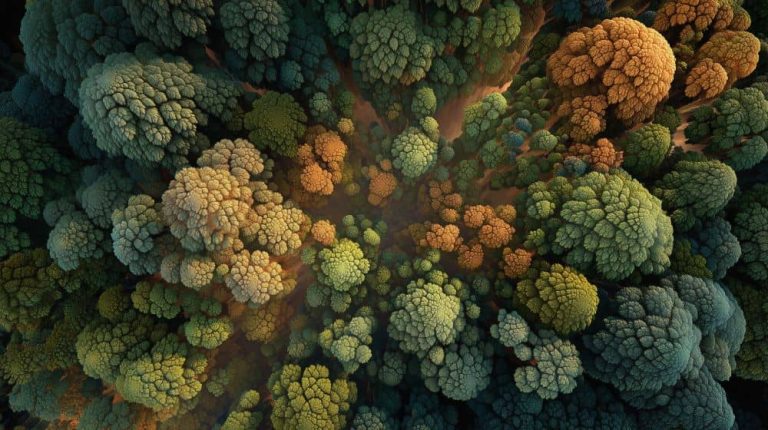
Forest and woodland scenes work well, especially when they suggest depth and the possibility of walking into the scene. Your brain seems to respond to these as inviting, safe spaces.
Natural color palettes matter more than you might think. Soft greens and blues are consistently associated with stress reduction. Earth tones, gentle morning light, and muted natural colors tend to work better than vibrant, saturated hues.
Simplicity is key. Busy, highly detailed images can actually add to your cognitive load rather than reducing it. You want images that feel calm and ordered, not chaotic.
What to Avoid
High contrast, dramatic nature scenes like crashing waves, dark storm clouds, or dramatic cliffs might be visually striking, but they’re not necessarily calming. They can actually activate your stress response rather than calming it.
Similarly, heavily stylized or abstract interpretations of nature don’t seem to provide the same benefits as more realistic representations. Your brain seems to need to recognize the imagery as actual nature for the stress reducing effects to kick in.
Stress Relief Wall Art: Active Creation
Now let’s talk about the practice of actually making art, which is where the benefits seem to be strongest.
Why Creating Art Helps
There are several mechanisms at work here, and they all seem to contribute to the overall stress reducing effect.
Externalization: When you create art about your stress or emotions, you’re taking internal, often overwhelming feelings and putting them outside yourself in a concrete form. This can make them feel more manageable, less all consuming.
Mindful focus: The process of making art pulls your attention into the present moment. You’re focused on colors, shapes, textures, materials. This interrupts the rumination and worry that often fuels stress.
Non verbal processing: Sometimes stress and emotion are too big or too complex for words. Art provides a way to process and express these states without needing to articulate them verbally.
Sense of control: When everything feels chaotic and out of control, creating something gives you a space where you have complete control over what happens. This can be incredibly grounding.
Simple Practices You Can Try
You genuinely don’t need to be skilled or trained to benefit from art making for stress relief. Here are some approaches that research and practice have shown to be effective:
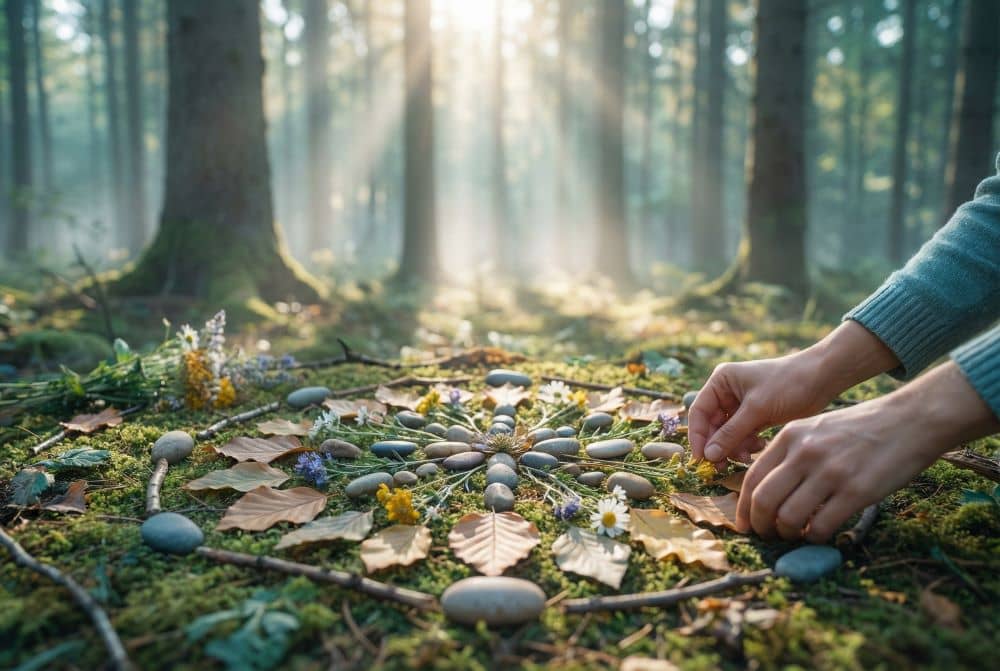
Nature mandalas are probably the most accessible. Go outside, collect natural materials, leaves, petals, stones, twigs, and arrange them in a circular pattern. The circular form is inherently calming, and the process of slowly, mindfully arranging objects is meditative. When you’re done, photograph it if you want to keep a record, then return the materials to nature.
Observational sketching is another powerful practice. Sit somewhere with a view of something natural, a tree, a plant, clouds moving across the sky, and slowly draw what you see. You’re not trying to create a masterpiece. You’re using the act of looking closely and translating what you see onto paper as a form of meditation.
Texture rubbings engage your sense of touch as well as sight. Place paper over bark, leaves, or interesting stones and rub gently with pencil or crayon. The textures that emerge can be surprisingly beautiful, and the process is simple enough that your analytical mind can rest.
Found object arrangements involve gathering natural items on a walk and creating simple compositions with them. The walk itself provides stress relief, and the creative arranging extends that benefit.
How Long and How Often?
Based on the research, short, regular sessions seem to work better than occasional long ones. About 10 to 20 minutes, three or more times per week, appears to be a sweet spot. That’s manageable for most people, and it’s enough to build cumulative benefits over time.
If you’re dealing with high stress, daily practice is even better. But even once or twice a week can make a noticeable difference.
Wall Art for Stress Relief: Choosing What Actually Helps
Let me give you a practical framework for choosing nature art that will actually support stress reduction rather than just looking nice.
Think about where you experience the most stress. Is it at your desk working? In your bedroom when you can’t sleep? In your living room at the end of a long day? Different spaces might benefit from different types of imagery.
For workspace stress, you want imagery that’s calming but not sleep inducing. Think clear morning light, soft greens and blues, organized natural scenes like a well composed landscape or a calm body of water.
For sleep related stress, you want imagery that’s genuinely restful. Deeper blues, twilight scenes, very soft edges and minimal detail. The goal is to cue your nervous system that it’s time to wind down.
For general living space stress, you have more flexibility. Consider what specifically stresses you. If you feel confined and claustrophobic, open landscapes with distant horizons might help. If you feel ungrounded and scattered, more enclosed nature scenes like forest interiors might be better.
Nature Wall Art: Understanding the Bigger Picture
Here’s something important that doesn’t get talked about enough. Nature art for stress relief isn’t just about individual psychology. There’s a broader context here about our relationship with the natural world and what happens when that relationship is broken or missing.
Most of human evolution took place in natural environments. Our nervous systems, our attention systems, our stress responses, all evolved in contexts that included constant contact with nature. Modern life removes most of that contact for most people. We spend the vast majority of our time indoors, in artificial environments, surrounded by human made objects and stimuli.
The stress reduction we experience from nature art isn’t really about nature being some magical cure. It’s more like we’re correcting a deficiency. We’re giving our systems something they evolved to need and expect but that modern life often doesn’t provide.
This is why even images of nature can help. Your brain doesn’t entirely distinguish between actual nature and realistic representations of it. The visual input triggers similar responses. It’s not as strong as actually being in nature, but it’s significantly better than no nature contact at all.
Comparing Different Approaches
Let me break down how different nature art approaches compare in terms of stress relief benefits:
| Approach | Stress Reduction | Time Investment | Skill Required | Accessibility | Best For |
|---|---|---|---|---|---|
| Viewing Nature Art (passive) | Moderate | None (ongoing) | None | Very High | Daily stress buffering |
| Nature Mandalas | High | 15-30 min | None | High | Accessible creativity |
| Observational Drawing | High | 20-40 min | Low | Medium | Mindfulness practice |
| Guided Art Therapy | Very High | 60+ min/week | None | Low | Clinical level stress |
| Nature Photography | Moderate to High | Variable | Low to Medium | Medium | Active engagement |
| Collage with Natural Materials | Moderate to High | 20-40 min | None | High | Tactile processing |
A few notes on reading this table. “Stress Reduction” refers to the magnitude of benefits based on available research. “Time Investment” is per session. “Accessibility” considers both practical barriers and the ease of getting started.
The sweet spot for most people seems to be simple, repeatable practices like mandalas or observational sketching, combined with having quality nature imagery in their daily environment. This provides both active engagement when you have time and energy, and passive support the rest of the time.
When It’s Not Enough
Let’s be really clear about something important. Nature art can be genuinely helpful for stress management, but it’s not a replacement for professional mental health care when that’s what you need.
If your stress has been persistent for weeks or months and isn’t improving with self care strategies, if it’s affecting your sleep, your appetite, your relationships, or your ability to function at work, that’s when you need to talk to a mental health professional.
Similarly, if you’re experiencing persistent anxiety, feelings of hopelessness, or any thoughts of self harm, please reach out for professional help immediately. Nature art can be part of a comprehensive treatment plan, but it shouldn’t be the entire plan when you’re dealing with clinical level mental health challenges.
Research on nature-based interventions shows they work best as part of an integrated approach. They support and enhance other treatments rather than replacing them.
My Personal Take After Diving Deep
After spending months looking into this, both the research and my own experimentation, here’s what I’ve concluded.
Nature art for stress relief genuinely works for most people. It’s not a placebo effect or wishful thinking. There are measurable, reproducible benefits that show up consistently across different studies, different populations, and different methods.
But it works best when you think of it as one tool in a larger toolkit, not as the only tool or the magic solution. It’s particularly effective for managing everyday stress, the kind that comes from modern life and doesn’t necessarily rise to the level of a diagnosable condition.
The passive benefits from simply having nature imagery in your environment are real but modest. Think of this as your baseline, your minimum intervention. It’s better than nothing, and for some people it’s enough.
The active practice of creating art with or about nature provides stronger benefits, but requires more time and engagement. The good news is you don’t need talent or training. The process itself is what matters, not the product.
The strongest benefits seem to come from regular, repeated practice over time. This isn’t a one and done intervention. It’s more like exercise or meditation. You get some immediate benefits, and you get cumulative benefits from consistent practice.
What I’d Recommend Trying
If you’re curious about whether this might help you, here’s a practical, graduated approach to testing it:
Start simple. Add one or two pieces of quality nature imagery to the space where you experience the most stress. Choose images that feel genuinely calming to you, not just what looks impressive. Live with them for a couple of weeks and notice whether you feel any different.
Try one easy creative practice. On a weekend when you have 20 minutes, try making a nature mandala. It’s simple, requires no skill, and you’ll know within that single session whether it feels helpful or not.
If it feels good, build on it. Add more nature imagery to your environment. Try other simple creative practices. Consider whether a more structured approach, like a guided course or working with a therapist, might be helpful.
Give it time. Benefits can appear after a single session, but they’re stronger and more stable with repeated practice over several weeks. Don’t judge too quickly whether it’s working or not.
Be realistic about expectations. This probably won’t transform your life overnight, but it might make your daily stress more manageable, which is actually quite valuable.
The Bottom Line
So, does nature art for stress relief actually work? Yes, for most people, to a meaningful degree, especially with regular practice.
Is it a cure for all stress and anxiety? No, and anyone who tells you it is should not be trusted.
Is it worth trying? Almost certainly yes, especially given how accessible and low risk it is. The worst case scenario is you spend some time looking at pleasant images or making simple art and don’t get much benefit. The best case scenario is you discover a practice that genuinely helps you manage stress more effectively.
The thing that strikes me most about this whole area of research is how it highlights something we kind of already knew but often ignore. We need nature. Not just as a nice to have or a weekend recreation option, but as something fundamental to our wellbeing. Our brains and bodies evolved expecting constant contact with natural environments, and when we don’t get that, we pay a price in stress, anxiety, and depleted mental resources.
Nature art, whether it’s creating it or simply viewing it, is one way to address that deficit within the constraints of modern life. It’s not perfect. Actually being in nature is better. But it’s accessible, practical, and based on the research, genuinely effective.
Your stress is real. The pressures and demands of modern life are real. You deserve tools that actually help. Nature art won’t solve everything, but for many people, it can be part of the solution. And in a world where stress often feels overwhelming and solutions feel out of reach, that’s worth paying attention to.
Try it. Give it a real chance, not just one half hearted attempt. Notice what happens. And remember that taking even small steps to manage your stress is an act of self care that matters.
You’re not going to eliminate stress from your life. That’s not realistic and probably not even desirable. But you can learn to navigate it better, to have tools and practices that help you return to baseline more quickly, that prevent stress from becoming chronic and overwhelming.
For a lot of people, amazing nature art is one of those tools. It might be for you too.